 John Allpress - English FA
Introduction This article is based on my experience in developing coaches for professional soccer clubs in England. The lessons from this may have much to offer coaches in other countries. This article focuses specifically on learning from mistakes in soccer. Learning in soccer Learning new ideas and skills can be like riding a roller coaster ride for the learner – some days’ things seem easy, other days almost impossible. Things can vary depending on what you’re doing, how you’re feeling, whether you’re growing and lots of other things too. Learning new things can be the best or the most scary experience you’ve ever done because if you’re truly learning you don’t really know what to do. This meanslearners can be fragile or strong and either can easily change. There are many factors that are also constantly changing, developing and evolving –but there is one constant – the learner. The ultimate responsibility forlearning sits squarely with the player and not the coach. Coaches are not there primarily to show or tell players what they know; they are there to create environments for learning that are varied and challenge the players and to provide them enjoyment and a degree of security and support. Coaches should also give players choice and ownership allowing them to practice and experiment with new techniques, skills or tactical ideas they present in training. Practicing, Experimenting and Competing We learn soccer in three different ways: • by practicing • by experimenting • by competing These activities require different mind sets. While there is no substitute for practicing to get better at things, experimenting and competing also have a major role in the process. As coaches our understanding of where these different modes of play sit within learning is vital if the players are to be supported effectively. Research has shown that it takes around 10,000 hours of practice and experimenting to get really good at complicated skills like soccer techniques or playing the violin. Interestingly the very best players spend a larger percentage of their10,000 hours working away from their coaches on their own or with their friends in informal activity. In soccer when practicing passing, receiving, shooting or dribbling the aim should be precision, efficiency and reliability and such repetition should lead to smooth, effortless, automated expertise. But simply practicing can also make players rigid and predictable. So after practicing for a bit, players need to try something different. They need to play around with the techniques, skills and tactics and see what happens. A simple example may be to try out new techniques and skills with the weaker footor see what happens when you cross the ball into the penalty area earlier orlater than the coach has suggested. Players need to experiment with the new skills and concepts they have practiced. Practice gives players the foundation for experimenting. Experimenting develops flexibility and the ability to be unpredictable; the perception to see the tiny differences in an opponent’s body position or a team mate’s movement that cannot be seen from the sideline by the coach. Experimenting helps develop creativity, innovation and inventiveness – hallmarks of the best and most effective football players. But experimentation can lead to things going wrong and mistakes being made. When young players compete in matches they are not the finished article. They should always strive to win but never be afraid to push the barriers and experiment, even during matches. In order for this to happen the coaches need to be mentally strong and to understand their temporary place in the evolution of the developing player – in other words the coaches should endeavour to put the learning needs of the players first and model learning and the behaviour that goes with it. Send out the message that you ‘don’t like experimenting’ and the players will stop doing it and their learning will be hindered as a result. Guy Claxton [Professor of Learning Sciences at Bristol University, UK] says ‘Learning is what we do when we don’t know what to do,’ and ‘if we don’t know what to do sometimes we’ll get it wrong and mistakes will happen’. The big question is how can players and coaches use this to their advantage? Firstly players need to know whether they are expected to practice or experiment. Practicing is aimed at precision, efficiency and reliability. Experimenting ispushing the limits of our practice so that we can see what may happen if we tryit this way or that. If coach and players get their wires crossed and one thinks it practice when theother thinks it is experimenting chaos and breakdown in communication will occur. Secondly, coaches need to clarify the learning objectives for the players - i.e. what isthis activity or drill all about? Understanding how players learn is central to the whole process – some learning is almost instantaneous but other learning takes time to be absorbed and become fluid and natural. Players that take more time to learn are not bad learners; they maysimply need more time – fast learning is not necessarily the best learning. After setting up a new learning activity the coaches first task should be to conducta needs analysis, i.e. who really needs my help? Am I just being self-indulgentand showing the players what I know? Listening to the players is a vital skill and one that coaches need to develop; also askingthe right questions in the right way and at the right time. Instructions should be clear and precise and directed at those players who need them. Players who do not need help should be given the time and opportunity to practice orexperiment without interruption. How do mistakes help learning? We might not like our players making mistakes but they do happen even when theplayers are experienced and know a lot about what they are doing. The fact that we talk about learning through trial and error suggests that the error part is not going to be eradicated. There is also our recognition that in order to win games of football there is often the need to take risks and try out new things learnt on the training pitch. This may mean attempting more difficult techniques, applying new skills orexperimenting with new strategies or tactics i.e. taking training into the game. If as coaches we encourage our players to take the actions that are required to learn new things we have to recognise that there will be errors. The question is how do we as coaches respond to our players making such errors? Highlighting mistakes Learning new things is a high risk business for the players. It means daring not to knowand it may mean facing up to the fact that you may not yet be as competent as others within your group or team. Therefore the player must see the relevance of the new technique, skill or tactic otherwisethey may perceive the risk of daring not to know as too great and not bother to try - staying within the boundaries of what they can already do instead. Therefore, motivation to learn is high on the agenda. During this transitional state players could be fragile and only highlighting their mistakes may not be the best way to encourage them to practice and experiment with new things. Players need to be given the license by the coach to experiment and try out new andexciting things, in doing so pushing out the boundaries of what they currently know or can do – moving on into the unknown. Highlighting mistakes may send out the message that not being able to do something is a personal flaw. Players may not want to risk being seen as incompetent or inadequate within their group and not try again. To create the right learning challenge for their players sometimes the most constructive response to mistakes from coaches can be a sort of ‘skilfulneglect’. In other words, leave the players alone as much as possible to workout as much for themselves as they can. The coach needs to recognise and acknowledge how players may be feeling when faced with new or difficult tasks i.e. ‘We’re now going to work with our weaker foot. I understand that things may go wrong and sometimes passes may not be as good as you would like but that’s OK. Just try to steadily improve thatweaker side.’ Become your own ‘coach inside your head’. It is possible to reflect on mistakes later when the emotion of the moment and the match has drained away. Some players will find developing this questioningprocess useful: • Where did the mistake occur? • When did it occur? • What did you do? • How did you feel aboutwhat happened at the time? • Why was it a mistake? • What did you learn? • How will you improve? Coaches can help players develop this process Possible problems with mistakes The biggest problem with mistakes is that fear of making them may well hinder ourdevelopment and evolution as learners and players. That is why it is important to reassess the role of mistakes in player development, recognise that they are merely staging posts on the learning pathway and can never be completely avoided. They can be costly in competitive matches but we are talking about player development which is a long-term process. Short-term reversal versus long-term gain is a price worth paying.
0 Comments
The modern day game requires the coach to have a knowledge and understanding of many aspects and be able to coach his players the different tactics required to win a match. Whilst there are many different aspects that go into producing a performance, in simplistic terms you either have the ball and are therefore attacking or the opposition have it and you are thus defending.
The top coaches in the World today focus on 5 issues surrounding the game which I have called the 5 Pillars. There are 2 pillars concerned with offensive play, 2 with defensive and then Set Pieces make the 5th. Offensive play is broken down into two categories, (1) In Possession with the opposition unset and (2) In possession with the opposition set and similarly defensively (3) out of possession and team unset and (4) out of possession and team set. 1. IN POSSESSION WITH THE OPPOSTION UNSET This situation arises at the moment when the team wins the ball back from the opposition and lasts for circa 6 seconds against a well organised team. This time span is the optimum amount when a goal can be scored, taking advantage of the likely spread out nature of the opposition who have been in attacking mode. They are likely to have an offensive mind as a unit and will undoubtedly be searching to get back into a defensive shape, but the time it takes to do this leaves them vulnerable to the counter attack, with defenders exposed individually and not being afforded any cover. This is an area the coach must spend time with his players on, devising strategies to take advantage of the turnover of the ball. To be successful in the game today, a team must defend in a manner to counter attack, i.e.; stop the opposition from scoring at the same time as understanding that the ball will be lost and for a brief period on winning it there is the maximum opportunity to punish them. Many of the World’s top teams have Transition players playing for them, players that take up ½ & ½ positions when defending, ready to fill holes and aid the defensive strategy if needed but also in positions to be able to effect the counter attack if the ball is won. AC Milan are one of the best teams to do this, with Kaka & Shevchenko always in positions when the rest of the team is defending where they can help out if needed but can receive the ball when it is won. In the game today this phase is the most important one in open play and is statistically responsible for over 1/3rd of all goals scored. Whilst it cannot be overestimated how important this phase is, it is equally important to recognise when the counter attack possibility is over and possession of the ball is the correct phase. 2. IN POSSESSION WITH THE OPPOSITION SET Fig 2. This is an area which needs to be addressed, as a counter attack opportunity can quickly fizzle out due to a foul, a misplaced pass or a well organised team which negates the counter attack by keeping/getting many players behind the ball. It is important in this phase to circulate the ball, provide options backwards, forwards and square for the man on the ball and to create space through movement and rotation to try to open the defensive block up so that it can be exploited. Too much risk in this area can lead to being counter attacked so covering your attacks must also be a focus when rehearsing your offensive moves. 3. OUT OF POSSESSION AND THE TEAM UNSET The importance of covering the attack cannot be stressed enough. Pushing too many players forward in search of a goal can be very risky as there is vulnerability about your shape immediately you lose the ball. It is vital that players are aware of where a counter attack is likely to initiate from and fill that area as quickly as possible. In the main, regardless of where the ball is lost a counter attack will be most successful if it is allowed to emanate from the central area in front of your defense. The first 6 seconds after losing the ball are the most dangerous for your team and the importance of gaining your compact defensive shape behind the ball as quickly as possible is paramount. Steps should be taken to identify the fulcrums of the counter attack and mark them tightly even when you are attacking, and also have a focus on slowing the game down immediately on losing the ball. Actions such as filling the central area in front of the defense with at least 2 players will encourage the opposition play wide to the flanks which you will then find easier to slow down the attack, have the nearest man to the ball press aggressively immediately the ball is lost to force the ball backwards, again slowing it down and also if this aggressive press leads to a foul then again the game is slowed down for the restart enabling you to get back to your compact defensive shape as a unit. 4. OUT OF POSSESSION AND THE TEAM SET Whatever your defensive principles this is the situation when you should be at your most resolute and difficult to break down. Forcing the opposition to play in a way that you want them to play should be addressed and having your transition players in ½ & ½ positions ready to counter when you win it….. 5. SET PIECES Quite simply set pieces are responsible for over 1/3rd of all goals scored. Set Pieces need to be worked on religiously during training in order to be successful with them. The 2 key areas of offensive set pieces are delivery and attitude to be on the end of the delivery. Whatever the practiced set piece is, the delivery must be constant into the target area and the players must be well drilled to attack that area and do so with conviction and belief. Defending set pieces requires organisation and a commitment to get the first touch on the ball coming in as this is a fundamental objective in reducing the amount of goals conceded. When devising the way you want your team to play, using the 5 pillars as the foundation of what you are trying to achieve will help a great deal in making your team a successful one. The complexity of all the different aspects and tactics involved within those pillars is for you to determine and organise but a constant reference to them is essential. 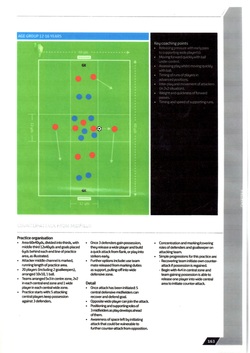 An up-to-date session plan being delivered with a modern approach. Well, that’s my aim every time I step on to the field.
Sometime it doesn’t always work out that way, but at least I know I’ve given it a damn good try. This session, “Counter Attack from Midfield” I have run a few times with different groups inclusive of the Jersey FA Centre of Excellence and a couple of local clubs where I have been given the opportunity to come in and work with their youngsters. As we know, even the most in depth planning can be cast aside once you turn up and the number of kids is different, some times less, sometimes more. You may only have one goalkeeper; the area you have is smaller than you thought; the ability is very mixed; the attitude and desire of players varies considerably; etc etc. So I do always try to prepare for a change in circumstances and have a back up plan for different scenarios. The session is very enjoyable when it goes fluidly and learning appears to take place effortlessly (as they all are), but sometimes you hit a few stumbling blocks that as a coach you need to overcome and sometimes think on your feet. The format I have adjusted to accommodate extra or fewer players turning up last minute than expected. This has been done by having a 4v2 in the centre with 2 defenders vs 1 attacker in each end, and also 6v4 in the centre and 2v2 in the end zones. Tip: try to keep the sides even across the midfield zone (inlcusive of wingers). Without going into too much detail now, this is a session that I have in my Youth Module 3 pack, where I need to write up the evaluation form for it. Once completed, I will share with you for your feedback. As a coach if you haven’t tried this session with your current team (suitable for teenagers) challenge yourself as a coach and give it a go. Take yourself out of your comfort zone and try something new; you never know, you may just surprise yourself. |